
4SO · Infrastructure software
Infrastructure that stays operable.
4SO builds products for platforms, databases, DNS, email, workspaces and networks. They run in your own environment, and after day one they keep a clear, traceable path through scaling, upgrades, failure and recovery.
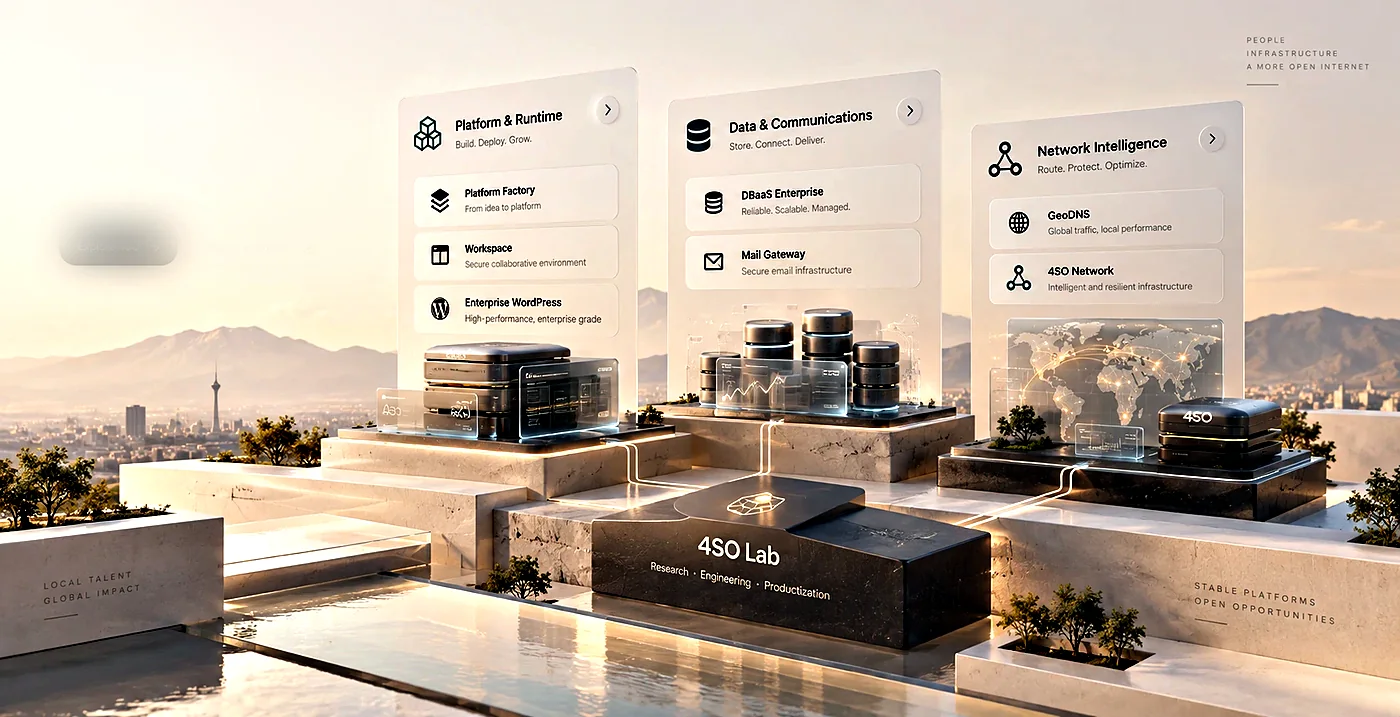
Seven products, each owning one clear problem.
Each product covers one operational domain, from installation to daily operation. You can adopt just one; all of them share the same operational contract.
Platforms and execution

 4SO Platform Factory
Turns raw servers or existing clusters into standard Kubernetes platforms, then runs build, upgrade and recovery from one management surface.
Product page →
 4SO Workspace
Delivers Linux browsers, desktops, apps and remote access in the browser, keeping execution and data off the user’s device.
Product page →
 4SO Enterprise WordPress
Makes every WordPress site a managed resource, with identity, backup and recovery, capacity and safe updates.
Product page →
Data, DNS and communications
 DBaaS Enterprise
Runs ten database engines as a service, with engine-native topology and HA, backup, upgrade and a stable endpoint.
Product page →
 4SO GeoDNS
Runs authoritative DNS and traffic routing through versioned changes, blue/green delivery and DNSSEC; serving never depends on the Manager.
Product page →
 4SO Mail Gateway
A self-hosted mail platform for high-volume sending and protected receiving, with multi-tenant operations and a traceable lifecycle.
Product page →


Infrastructure is more than installation.
Day one matters, but the real cost and risk start on day two: capacity changes, failures, upgrades, recovery, access and observability. When this work is scattered across tools and people, operational quality depends on the team's memory.
- 01
Operational complexity
High availability, replication, backup, recovery, routing and policy each have their own behaviour and limits. Keeping all of them right together is an operational problem, not just a software install.
- 02
Reliance on individual expertise
When the right procedure lives only in one DBA's, sysadmin's or SRE's head, repeatability, handover and recovery under pressure all get harder.
- 03
Change risk
Scaling, upgrades and failover run without preflight checks and result verification can themselves become the source of an outage.
- 04
Conflicting stories
Panel, API, scripts and automation should work from one state model, not each give a different picture of service health.
One shared path, from request to verified result.
In 4SO products you can start from the panel, the API or the assistant, but every change follows one controlled path: the request is recorded, access and preconditions are checked, the operation runs, and the real state of the service confirms the result.
A request enters from the console, the API or the AI assistant.
- 01
AI has no shortcut
AI does not get a separate path for sensitive changes; it goes through the same authorization and approval.
- 02
Accepted is not succeeded
An accepted request is only the start; success is confirmed by the real system.
- 03
The control plane is not in the service path
In products with an independent data plane, a management outage does not stop the service.
- 04
No fake health
When data is missing, the product shows the state as unknown, not healthy.
Shared lifecycle
- 01PreflightCheck first
- 02ProvisionBring up
- 03ValidateConfirm
- 04OperateRun
- 05ScaleGrow
- 06UpgradeMove forward
- 07RecoverRestore
- 08ObserveWatch
4SO Lab
20 years of hands-on experience × AI × engineering discipline.
4SO Lab is how 4SO builds products. Human experience defines the problem and its context, automation and AI speed up analysis and execution, and independent validation decides what can actually be relied on.
- 01Human experience defines the problem, its limits and the real impact of a decision.
- 02AI and automation help with analysis, implementation and testing, never to bypass controls.
- 03Every result is checked again against evidence, tests and the real state of the system.
Planning an infrastructure project?
Tell us what you want to run, in what environment and at what scale. We will work out together which product and which deployment model fit.